Langur Eco Travels · Birding guide
Birding in Bhutan
Bhutan is a small country with an outsized bird list. More than 700 species have been recorded here, in a kingdom roughly the size of Switzerland, and you can travel from subtropical foothills at 200 metres to alpine passes above 4,000 metres in a single day. That compression of habitat is the reason birders keep coming back.
- 700+bird species recorded
- 200–4,000 mof habitat in a single day
- 70%+of the country under forest
 Ward’s Trogon, eastern Bhutan
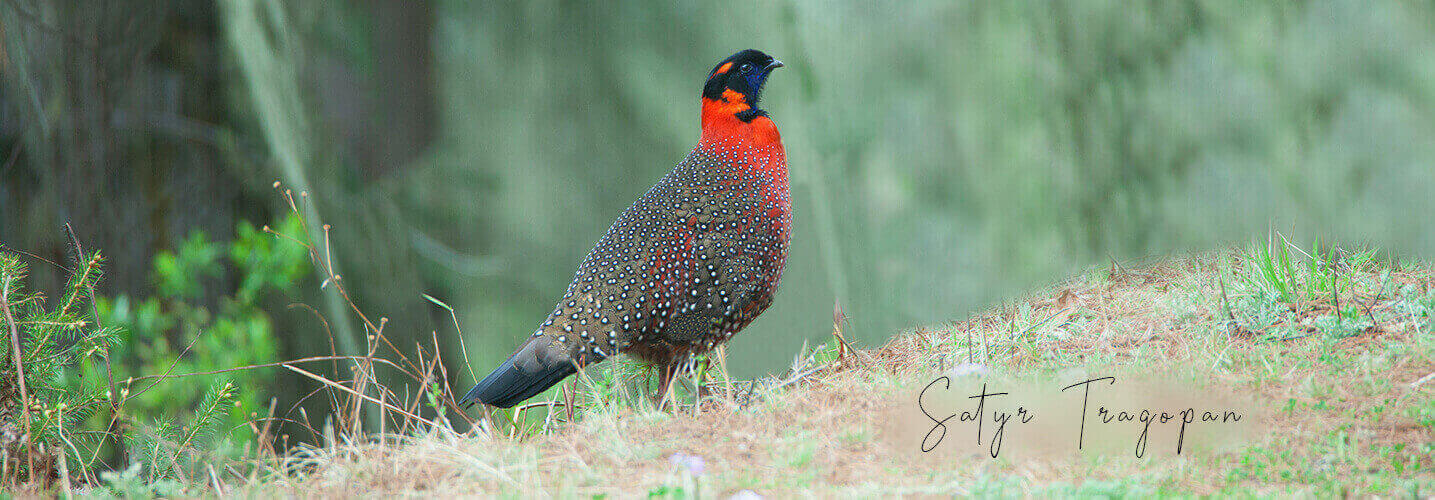 Satyr Tragopan, Pele La
 Rufous-necked Hornbills, Morong valley
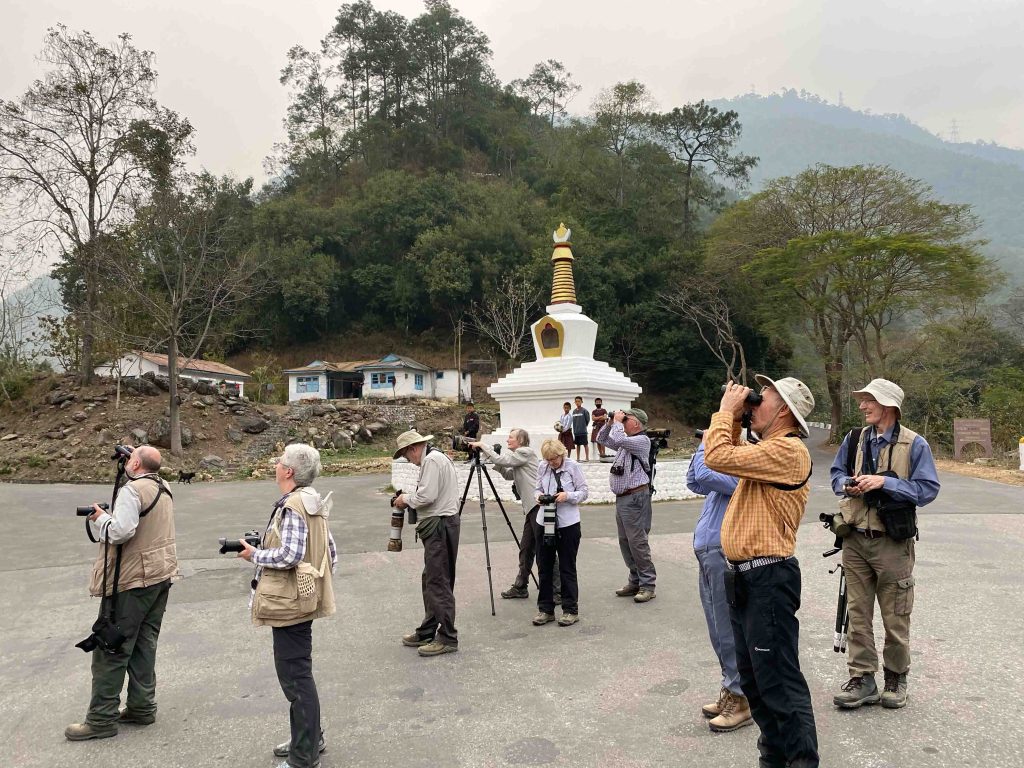 On tour with our guests
Langur Eco Travels is a Bhutanese birding company. Our guides have spent years working the same forests, passes and river valleys described on this page, and every photograph in our Birds of Bhutan gallery was taken on one of our own tours. This page is our guide to birding in Bhutan: where to go, what you can realistically hope to see, when to come, and how to put a trip together.
Why Bhutan is one of Asia’s best birding destinations
Three things set Bhutan apart from the rest of the Eastern Himalayas.
The forest is still standing. More than seventy percent of the country is under forest cover, and the constitution requires that at least sixty percent stays that way in perpetuity. Over half of Bhutan sits inside national parks, wildlife sanctuaries and the biological corridors that connect them. Elsewhere in the Himalayas you bird the fragments that survived. In Bhutan you bird continuous forest from the plains to the treeline.
The altitude range is unbroken. A single road, the east-west highway, crosses several high passes and drops into several river valleys. The Lingmethang road in the east descends from over 3,700 metres at Thrumshing La to under 700 metres at Lingmethang in about sixty kilometres. Every band of that descent holds a different community of birds.
There are very few people in the way. Bhutan limits and manages tourist numbers deliberately. On most mornings you will be the only vehicle at the viewpoint.
For background on the country itself, see Bhutan at a Glance.
Where to go birding in Bhutan
Western Bhutan: Paro, Chele La and Punakha
Most trips begin in Paro, where the international airport is. The Paro and Thimphu river valleys are good for wintering waterbirds, and Ibisbill is a regular target on the shingle beds in the colder months. From Paro the road climbs to Chele La at 3,988 metres, the highest motorable pass in the country, through hemlock and fir forest that holds Blood Pheasant, Himalayan Monal and Kalij Pheasant along the roadside in the early morning.
Dropping east, the Punakha and Wangdue valleys are warm, low and rich. The Punatsangchhu river is one of the last strongholds of the critically endangered White-bellied Heron, of which only a few dozen mature individuals are thought to survive worldwide. Lampelri Royal Botanical Park, on the road between Thimphu and Punakha, is an easy and productive first morning.
Read more on birding in central and western Bhutan and on Jigme Dorji National Park, the largest protected area in the country.
Central Bhutan: Phobjikha, Pele La and Bumthang
The glacial bowl of Phobjikha Valley is where Black-necked Cranes spend the winter, arriving from the Tibetan plateau in late October and leaving again in February. It is one of the great wildlife spectacles of the Himalayas, and the valley is protected specifically for them.
Further east, Pele La and the forests around Tharpaling monastery in Bumthang give access to high-altitude pheasants and rhododendron-belt species, and Jigme Singye Wangchuck National Park connects the central highlands down to the southern foothills.
Eastern Bhutan: Yongkola and the Lingmethang road
If you only bird one place in Bhutan, bird this one. The descent from Sengor through Yongkola to Lingmethang, inside and below Thrumshing La National Park, is regarded by many visiting birders as the single finest stretch of road in the Eastern Himalayas.
This is the country for Ward’s Trogon, Beautiful Nuthatch, Rufous-necked Hornbill, Chestnut-breasted Partridge, Satyr Tragopan, Himalayan Cutia, Spotted Laughingthrush and the mixed feeding flocks that move through the broadleaf forest in waves. Rufous-necked Hornbill display here in spring. Sengor, higher up, is reliable for Satyr Tragopan in the early morning.
See birding in eastern Bhutan for more on this route.
The southern foothills: Tingtibi, Gelephu and Samdrup Jongkhar
The subtropical south adds a completely different list: hornbills, barbets, drongos, storks, herons and open-country species that never occur higher up. Tingtibi, the Gelephu wetlands and the road down to Samdrup Jongkhar are the usual points of access, and Royal Manas National Park in the far south holds Bhutan’s tropical biodiversity, including tiger, elephant and Golden Langur.
The birds you come to Bhutan for
No honest operator will promise you a species. These are the birds that shape most itineraries, and the places we look for them.
![A flock of Black-necked Cranes on a ploughed field in Bhutan]() Black-necked CranePhobjikha and Bumdeling, late October to February
Black-necked CranePhobjikha and Bumdeling, late October to February- Critically endangeredWhite-bellied HeronPunatsangchhu and the lower river valleys, all year but easiest in winter
![Male Satyr Tragopan on a mossy slope at Pele La, Bhutan]() Satyr TragopanSengor and the high broadleaf forest, spring
Satyr TragopanSengor and the high broadleaf forest, spring![Ward's Trogon perched on a moss-covered branch in Bhutan]() Ward’s TrogonYongkola and the Lingmethang road
Ward’s TrogonYongkola and the Lingmethang road![Beautiful Nuthatch on a sloping branch in Bhutan]() Beautiful Nuthatchthe mid-altitude broadleaf belt in the east
Beautiful Nuthatchthe mid-altitude broadleaf belt in the east![A pair of Rufous-necked Hornbills on a bare branch in Morong valley, eastern Bhutan]() Rufous-necked HornbillYongkola, Tingtibi and the foothills
Rufous-necked HornbillYongkola, Tingtibi and the foothills![Himalayan Monal on a high pass in Bhutan]() Himalayan MonalChele La and the other high passes
Himalayan MonalChele La and the other high passes![Blood Pheasant in fir forest near the treeline in Bhutan]() Blood Pheasantfir and hemlock forest near the treeline
Blood Pheasantfir and hemlock forest near the treeline![Chestnut-breasted Partridge in the forest at Yongkola, Bhutan]() Chestnut-breasted PartridgeYongkola, a Bhutan and Arunachal speciality
Chestnut-breasted PartridgeYongkola, a Bhutan and Arunachal speciality![Ibisbill on river shingle in the Paro valley, Bhutan]() Ibisbillriver shingle at Paro and Punakha, winter
Ibisbillriver shingle at Paro and Punakha, winter


Our exotic birds of Bhutan and endangered birds of Bhutan pages go into more detail, and the Birds of Bhutan gallery shows what our own groups have photographed, with the site and the month for each bird.
When to go birding in Bhutan
- Jan
- Feb
- Mar
- Apr
- May
- Jun
- Jul
- Aug
- Sep
- Oct
- Nov
- Dec
- Spring
- Autumn
- Winter
- Monsoon, no birding tours
Spring: March to May
The most popular season, and the best one for a first visit. Birds are singing and displaying, so they are far easier to find, and the rhododendron forests are in flower. Pheasants are vocal at dawn. See springtime birding in Bhutan and birds and rhododendrons of Bhutan.
Autumn: October to November
Clear skies, settled weather and the best mountain views of the year. Migration is moving through, the first Black-necked Cranes arrive in Phobjikha, and the trails have dried out after the monsoon. See autumn birding in Bhutan.
Winter: December to February
Cold at altitude and quiet on song, but this is the season for the cranes, for Ibisbill on the rivers and for the best chances with White-bellied Heron. See winter birding in Bhutan.
The monsoon, roughly late June to early September, brings heavy rain, leeches and landslides, and we do not run birding tours then. For a broader seasonal view, see when to visit Bhutan.
Our birding tours in Bhutan
Every itinerary below is one we run ourselves, with our own guides and drivers.
-
![Blood Pheasant on the forest floor]() 7 days / 6 nights
7 days / 6 nightsShort Bird Watching and Cultural Tour in Bhutan
A compact introduction to western Bhutan
- Blood Pheasant
- Himalayan Bluetail
- Alpine Thrush
FromUS $2,200per person -
![Ward’s Trogon on a mossy branch]() 10 days / 9 nights
10 days / 9 nightsShort Bird Photography Tour in Bhutan
Built around the Lingmethang road
- Ward’s Trogon
- Beautiful Nuthatch
- Blyth’s Kingfisher
FromUS $3,360per person -
![Golden Langur, one of Bhutan’s most endangered primates]() 12 days / 11 nights
12 days / 11 nightsIn Search of Birds, Mammals and Flowers of Bhutan
- Golden Langur
- Wallcreeper
- Collared Scops Owl
FromUS $4,000per person -
![Himalayan Monal in Bhutan]() 13 days / 12 nights
13 days / 12 nightsLuxury Bird Watching and Cultural Holiday in Bhutan
- Himalayan Monal
- Hoary-throated Barwing
- Scaly Laughingthrush
FromUS $4,360per person -
![Fire-tailed Myzornis]() 15 days / 14 nights
15 days / 14 nightsMost Popular Birding and Mammal Watching Tour in Bhutan
- Fire-tailed Myzornis
- Capped Langur
- Himalayan Cutia
FromUS $5,080per person -
![Great Parrotbill]() 16 days / 15 nights
16 days / 15 nightsBest Bird Photography Tour in Bhutan
- Great Parrotbill
- Blue-capped Rock Thrush
- Golden-breasted Fulvetta
FromUS $5,440per person -
![Great Hornbill]() 17 days / 16 nights
17 days / 16 nightsBudget Birding and Cultural Tour in Bhutan
- Great Hornbill
- Hodgson’s Frogmouth
- Siberian Rubythroat
FromUS $5,840per person -
![Wreathed Hornbill at Samdrup Jongkhar]() 18 days / 17 nights
18 days / 17 nightsBirding in Unexplored Areas of Bhutan
- Wreathed Hornbill
- Tawny Fish Owl
- Sultan Tit
FromUS $6,200per person -
![Satyr Tragopan at Pele La]() 19 days / 18 nights
19 days / 18 nightsSpring Birding and Wildlife Tour in Bhutan
Our most complete route
- Satyr Tragopan
- Long-tailed Broadbill
- White-winged Grosbeak
FromUS $6,560per person


If none of them fits your dates or your target list, we will build one that does. Start with a customised birding trip, or read our trip reports to see how past tours went.
Photographing birds in Bhutan
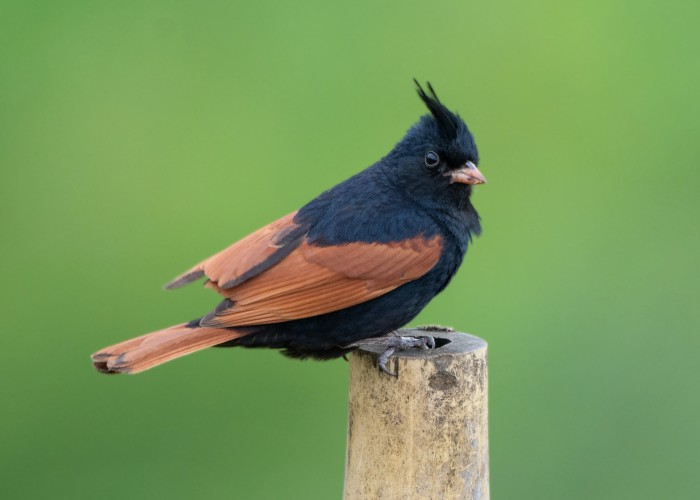
Bhutan is demanding for bird photography. Most of the good forest is dark, the birds are often high in the canopy, and the weather changes hour to hour. A few things that make the difference on our photography departures:
- A long lens and a fast shutter speed matter more than resolution. Much of your shooting will be at high ISO under closed canopy.
- Bring a tripod or a beanbag for the vehicle window. A lot of roadside birding in Bhutan is done from the car.
- Mornings are everything. Activity drops sharply once the valley mist burns off.
- Keep your distance from displaying and nesting birds, and never use playback at a nest. Our guides follow the same rule.
See our bird photography tours and our notes on photography and birding etiquette.
Planning a birding trip to Bhutan
Independent travel is not how Bhutan works. Apart from Indian nationals, all visitors book through a licensed Bhutanese operator, travel with a licensed guide, and pay the Sustainable Development Fee for each night in the country. That fee funds free healthcare, free education and conservation work, which is a large part of why the forest you came to bird is still there.
The practical details are on these pages:
Birding and conservation in Bhutan
Bhutan is a carbon negative country that has written environmental protection into its constitution. For a birder that is not an abstraction: it is why the Lingmethang road still passes through unbroken forest, why the cranes still return to Phobjikha, and why a handful of White-bellied Herons still hold on along the Punatsangchhu.
Our guides submit sightings to eBird, contribute photographs to the record, and support the annual crane and heron counts. Tourism revenue is a direct part of what pays for that protection.
Frequently asked questions
How many bird species are there in Bhutan?
More than 700 species have been recorded, and the list is still growing. A well-planned two-week tour across the full altitude range will typically record between 300 and 400.
What is the best time for birding in Bhutan?
March to May for song, display and the widest species list. October to November for clear weather and the arriving cranes. December to February for Black-necked Crane, Ibisbill and White-bellied Heron.
How physically demanding is birding in Bhutan?
Most birding is done along roads and forest tracks at a gentle pace, so it suits a wide range of fitness levels. The real demands are long drives on winding mountain roads, early starts, and altitude on the passes, where Chele La and Thrumshing La both exceed 3,700 metres.
Can I combine birding with Bhutan’s culture and festivals?
Yes, and most of our clients do. Several itineraries are built around a tsechu, the masked dance festivals held at the dzongs through the year. See our scheduled cultural tours.
Do I need my own guide and vehicle?
Yes. Bhutanese regulations require a licensed guide, and all of our tours include a dedicated birding guide, driver and vehicle for your group.
Plan your birding trip to Bhutan
Tell us your dates, how long you have and the birds you most want to see, and we will send back a route that makes sense for all three. We are based in Bhutan, we guide our own tours, and we will tell you honestly what is realistic in the time you have.
Contact Langur Eco Travels or start a customised birding itinerary